Anthony M. Carrozzo, OFM, “Telling Our Stories”
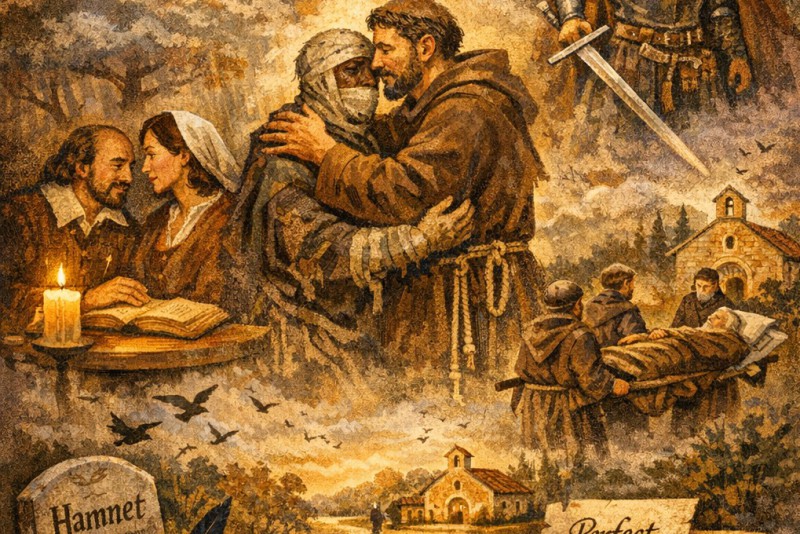
Tell me a story are words children often use at bedtime, sometimes to put off sleep, other times to induce it. It is also the singularly important phrase novel and movie Hamnet. Agnes, the future bride of Shakespeare, asks him to tell a story which he does. However, if we think that is the end of it, we miss the meaning of those words because Tell me a story is the basic theme of the entire work. Over and over again the story is told about their life together, their happiness, their sorrows and their pain at the loss of their son Hamnet on which the play Hamlet is written and performed for their healing. The message is clear: stories heal us. It is an enlightening revelation born of much suffering.
In a wonderful twist of phrase, O’Farrell writes “The house whistles with draught.” Yes, and with looming suffering as well, as the grandmother foretells “What is given may be taken away at any time. Cruelty and devastation await you at every turn.” Even suffering, though, gradually reveals it’s healing beauty.
Franciscans could also say Tell me a story. However, it would not be as easy for us as it was for Agnes and Young Shakespeare. Their story was consistent. The Franciscans have any number of stories from which to choose. Some stories are supportive of each other, while other stories are told to oppose other stories. Some are authentic, some not. Some motivate us more than ot. Some challenge us. Some heal us. In all cases, they make us who we are.
What’s happens is that one person might begin with the story of the Crucified speaking to the Poverello. Another might prefer the story of francis’s transformative encounter with the leper. For many of us though the first story that comes to mine is the story of perfect joy because in daily life we are often want to say when something seemingly unjust happens to us we cry out perfect joy, perfect joy!
The story of perfect joy is far from dependable. It is only recorded in the Little Flowers of Saint Francis, a fourteenth-century highly imaginative retelling of the life of Saint Francis. It was written by the spiritualist wing of the Franciscan Movement to promote their agenda which was a longing for the early Franciscan spirit that they felt had disappeared. For this they were persecuted by their more compromising brothers. To defend themselves, they told the story of perfect joy. To make the story about Francis and not themselves would give more credence to their story.
Donna Trembinski in Illness and Authority investigates the many illnesses of Saint Francis required his withdrawal from leading the Order into the future. He was not rejecteed but voluntarily withdrew. At the same time, his relationship with the Lord had so consumed him that he preferred to be alone with Him at Laverne.
In telling the early days of Franciscan life the brothers often treated one another violently, not with the love their evangelical lifestyle demanded. This is unfortunate but understandable given the violent atmosphere in which they lived their daily liveFrancis lived in that atmosphere.
As a young man Francis became involved in Assisi’s war with Perugia. There was no peace in the neighborhood so Francis wanted to be part of the violence. He outfitted himself as a knight, he mounted his horse to enter the war to fight against Perugia. This sense of chivalry was in his blood, desiring to be part of what was happening. It ended in catastrophe, A broken man, he headed home in disgrace.
On his return, the greatest transformation happened. It was the opposite experience of Paul of Tarsus. Francis was not thrown from his horse rather he voluntarily dismounted his horse to embrace the feared leper “turning what was bitter into sweetness,” ending his romance with violence. He became deeply opposed to violence. The only violence that we see in his own life is the way in which he treated his body. For that Francis later in life apologized to his body for the way in which he treated this Brother.
It is significant to note that in both of these situations – knight and leper encounter – were experienced by Francis while he was alone. Already he was far from the rowdy crowds of his youth. There is no wonder that later in his conversion, he desired to be alone, to be with the Lord.
Journey plays an important role in the death scene of Saint Francis. We all know the final scene all too well. Each year on the night before the feast of Saint Francis, we gather together to tell the story once again of his entrance into new life by welcoming Sister Death. That was only the final scene. First he had to forego his solitude and depend upon his brothers.
Francis wanted to return to the Portiuncula. The journey was exceedingly difficult and painful for Francis as well as for those brothers chosen to carry out this strenuous trip. Francis was at LaVerna where he had received the stigmata. He couldn not move easily or readily, sometimes not at all. His brothers were there to carry him down the mountain, through the towns, villages, and countryside until he arrived finally at what would be the scene of his death where it all began.
It is a lesson for all of us. We know it is not easy to welcome Sister Death. To get there we go through a similar journey that Francis went through. Aging takes away many of our freedoms. We grasp anew our understanding of poverty as we wait for the moment when we can say “Welcome, Sister Death.” In such circumstances, poverty becomes dependence.
Francis was a person of desires. He desired God more than anything else. Yet he also found much in his surroundings to desire: flowers and trees and sunsets of his desire to savor the cookies from his beloved , as well as brothers and sisters with whom to share this beauty while praying and living the gospel with them. And we never cease in telling how he enjoyed the cookies backed for him by brother Jacoba.
John Duns Scotus, one of the most brilliant Franciscan theologians after the time of Bonaventure, promoted the Pauline teaching that Jesus became Emmanuel because the Father had created everything that is for Him.. Jesus is “the first born of all creation,” Long before anything was created, long before the earth came to be,Jesus was in the mind of the Father: “everything that came into being was created in Him, with Him and through Him.”
When we desire something so profoundly, we do not count the cost. We simply want to fulfill those desires. Our theologies of sacrifice became so central to our spirituality, that it clouded our thinking seriously about our desires, whether profound or slight. In the Franciscan story desire replaces sacrifice as the motivation for growth in the spiritual life, echoing Saint Bonaventure, who tells us in the Itinerarium that to make the journey into God, we must be persons of desire.
“Then we will be the peacemakers that we are called to be,” bringing peace to every situationIn which we live. Pope Leo has challenged us to begin to look at this and to see that, while there are divisions and diversity among us, our task is to bring people to dialogue, to prayer, to a coincidence of opposites as Bonaventure would call it, to see that we are united in our humanity. The call is to treat each other humanely in every situation.
Some divisions in fact are good because they help us to see things from different angles and different perspectives. They also can be the source of much pain and anxiety. Instead of seeking to convert others to our way of thinking and being, we begin to listen to one another’s stories. Stories unite us, interpretations can divide us. We come to understand others when they tell us their stories and we hope that they will understand us better when we tell them our story.
What then is the Franciscan story you willl share? Why that one and not another? How does it enlighten your own story? As Maggie O’farrell observes in the novel Hamnet: “Every life has its kernel, it’s hub, it’s epicenter, from which everything flows out, to which everything returns.”
We cannot read these lines without being reminded that this is precisely the image that Bonaventure uses to describe Trinitarian life, flowing in and out. For both authors, it is a living, vibrant image that words alone cannot express. This happens when we share our stories, We discover ourselves and others anew.
Sources:
Maggie O’Farrelll, Hamnet, Headline Publishing Group 2021.
Donna Trembinski, Illness and Authority: Disability in the Life and Lives of Francis of Assisi, University of Toronto Press 2020.
Liam Kelly, Poverty, Peacemaking, and The Sacred: A Girardian Reading of the Early Franciscan Movement, Franciscan Institute Publications 2025.