Franciscan Core Values and Character: Practical Wisdom in a Digital World
Krijn Pansters
Introduction: Franciscan Virtuosity
Suppose your university asked you to develop a “Character Building” pillar for its Educational Profile. And suppose that university would be located in a Province of the country (of the Netherlands) which has traditionally housed a series of Franciscan monasteries and convents. To whom whom you (as a professor of church history, spirituality, and character building) turn for inspirational values, stories, virtues, and examples for your students? The Franciscan brothers and sisters! That is exactly what I did when I started a project that intended to make their core inspirations and ideas available and visible to students (and others) and to make their practice-oriented wisdom applicable in various societal contexts, e.g., personal leadership, care, and sustainability. What would be more fitting for that purpose than to focus on the Franciscan charism – “to observe the Holy Gospel of Our Lord Jesus Christ”[1] – and especially the “virtuosity” of the brothers and sisters, i.e., their well-tested tradition of dedicating one’s life to the well-being of others, a caring engagement with humanity and the environment, inclusion and respect for diversity, and personal growth and character building through moral virtues like courage, compassion, humility, and integrity.[2] In this article, I will therefore describe in broad terms how a selection of four Franciscan communities experience and express their core Franciscan inspirations and ideas on a day-to-day basis.[3] This mainly from the ethical perspective of “values and virtues” and how these can be made useful for character building in a society that has become largely secular.[4]
1. Caring
The Franciscan Sisters of the Immaculate Conception of the Holy Mother of God were founded in the village of Veghel, on June 24, 1844. From the start “their unique aim was the care of the needy in whom they recognized the suffering Jesus.”[5] In the strong tradition of this Franciscan Congregation and as workers of mercy in hospitals and schools, the Sisters have been giving special attention to the underprivileged sectors of society for over one and a half centuries.[6] The Sisters follow the Rule of the Third Order Regular of St. Francis, their main aim being to “steep ourselves in the Gospel and how Francis and our foundress have lived it.”[7] For the purpose of my project, I selected two ethical elements of their spiritual way of life. First, the mission of the congregation, as explained, for example, in the movie “The Story of the Sisters of Veghel.”[8] This is how the voice-over begins:
In 1844, the Congregation of the Franciscan Sisters of the Immaculate Conception of the Holy Mother of God was founded in Veghel to provide care, education and assistance to all in need. From Veghel, this religious organization spread around the world. In the 21st century, you can find the sisters of this congregation in Indonesia, Philippines, Kenya, Japan and Thailand. Wherever they live and whatever nationality they have, they are: Sisters of Veghel. The number of Dutch Sisters has been declining for many years and they are not getting any younger. They have reflected on their significance in society and have come to a courageous decision: the sisters are returning their motherhouse and the entire convent complex to the community to provide space for new initiatives building on their ideas.[9]
Ethically relevant and morally exemplary here are three things: the Franciscan organization of women who dedicated their (whole) lives to the care of the needy; the way of life spread and continues to attract young women all over the world; and the Dutch part of the congregation now, although out of necessity, returns even their most precious property, namely, their motherhouse, to society. From now on, their spiritual heritage will live on in a new “monastic quarter” as “eleven organizations from care, welfare, living, learning, and the municipality in the spirit of the Franciscan Sisters make a place for everyone: young, old, rich, poor, with and without disabilities.”[10] Although inevitable, their courageous act of giving up their own home is very reminiscent of Francis’ call to “return every good to the Lord God.”[11]
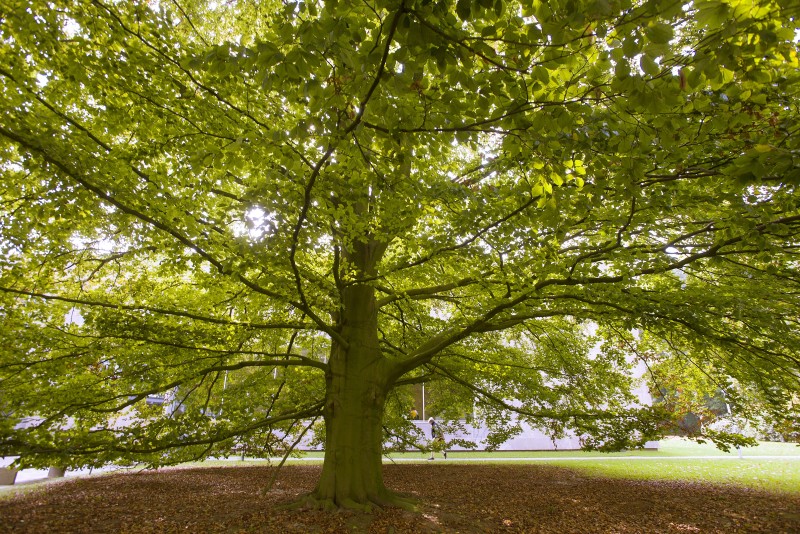
Second, the ten root words (grondwoorden) of the Franciscan Sisters of Veghel that symbolize their spiritual basic attitude (grondhouding). These are: “For the love of God, Being the lesser, Pray and work, Speaking boldly, Like trees in this ground, Giving and taking, Nowhere at home, Living everywhere, People who pass, and Stories that go on.”[12] On Veghel soil, the Sisters like to think of themselves as “trees in this ground,” deeply rooted both in the Franciscan-evangelical tradition and in the Veghel community. Those trees, by the way, should be taken quite literally: there is a beautiful row of old sycamores in the garden, symbolizing both the overwhelming beauty of creation and the long-standing rootedness of the Sisters. In the words of Provincial Superior Sister Maria Lourdes Santos:
A row of old sycamores, a characteristic feature in the garden of our motherhouse in Veghel. The trees are tall and majestic in appearance, they radiate a deep peace but are quiet in their wisdom. For 170 years they have sustained themselves in all seasons, blossoming again in spring, enjoying the sun in summer, weeping and suffering in autumn, enduring the storms and cold in winter. They give us the assurance that they will still be there long after we have all returned to the womb of Mother Earth. They received a great commission from the Creator, they make history and give us stories to pass on. In this way they tell the history of the “Franciscan Sisters of Veghel” and the traditions and values they stood for.[13]
Walking under these trees (while resting from action in a short moment of contemplation) will have been a profound experience for many Sisters. In the process of observing these symbols of life, next to that beloved convent cemetery, deep things will have gone through their minds. Among these will have been “Like trees in these grounds” and other roots words that in those precious moments once again established their identity and characterized their character.
2. Connected
The Brothers of Huijbergen, who take their name from the village of Huijbergen in the south of the Netherlands, were founded in 1854. They live according to the Rule of Life of the Regular Third Order of Francis. The founder of the congregation described the purpose of the brotherhood as being of service to fellow human beings by providing education and upbringing to the youth, especially the weakest among them. Today, the Brothers, all well into old age, offer space for personal reflection and opportunity for retreats and deepening activities in their guesthouse.[14] Jezus, Mary, and Francis being their main inspirations, they describe their mission as follows:
We choose to grow / in the spirit of Francis. Simple and close to what is true and joyful, related to each other on the way to a world / in which human beings and nature can come into their own. In this way we try to respond / to the voice of our hearts, free and grateful for everything / growing by the power of his love.[15]
The particularly exciting thing is that the “old” brothers of Huijbergen are hosting on their monastery grounds a “young” community that promotes a life in communion with nature: De Huijberg. This green community is working hard to create “a place with attention (aandacht) to earth (aarde) and breath (adem).” Their mission: a “place to live, work, catch your breath, get quiet, quietly work together in the house and the garden. Feeding your inspiration. Being nourished by a conscious natural life. We share this space of peace, work and hospitality.”[16] Even more exciting is that the brothers of Huijbergen (teachers and caretakers) and the members of De Huijberg (gardeners and artists) are inspiring each other very directly in their spiritualities.
While studying and visiting this congregation and community several times, I chose the following two ethical elements of the spiritual way of life at Huijbergen. First, there are the core values of the brothers as described in the latest internal documents. Under the influence of the community, they have become green, namely: growth, sources, spirituality, and forces. Concerning growth: “Within the community there is a focus on God, the sustaining force of all that lives and from from which we are connected to the earth and nature, to all living things. This growing is a process within which both the diversity of persons/characters and the diversity of experience and forms of expression are given a place.” Concerning sources: “For the shared future, inspiration and nourishment is found in various sources. Scripture and the writings of Francis form an important basis. [...] In addition, inspiration is found in books and studies on climate change and working to change human beings’ relationship to the earth. But inspiring publications also appear from within the Franciscan tradition. The living environment, nature and the encounter with people are also important sources of nourishment and inspiration.” Concerning spirituality: “Being able to be a lesser brother or sister for the sake of the poor other and the poor exploited earth is a challenge and task for everyone within the community. Am I able to let go of myself in such a way that the other can be the other and that precisely in this I can become or find myself.” Concerning forces: “A simple way of life frees and gives openness to others. But simple living also gives a connecting energy that transforms division into unity with the other because it is a life apart from possessions and status. Simple living also does justice to the earth because we do not ask more of her than what is necessary for our sustenance. In this way we also contribute to the unity between human beings and earth.” Having worked as teachers their whole lives all over the world, the brothers are now living out their root spirituality in connection to this particular place, here in the village of Huijbergen.
Second, the main inspiration and inspirational sources for the members of the Huijberg. Although their way of life and their website are not explicitly Franciscan, the links (and my interviews with them) reveal their Franciscan hearts. Most important to them is Francis’s Canticle of the Creatures: “Praised be You, my Lord, through our Sister Mother Earth, who sustains and governs us, and who produces various fruit with colored flowers and herbs.”[17] Then come the important green thinkers like environmental activist Joanna Macy, who sees the “climate crisis as a spiritual path.” Her questions are also the questions that the members of the Huijberg ask themselves: “How are we going to live our lives fully, with inner peace and courage (and even joy) as we confront a world that is destroying itself?”[18] Finally, there is the garden, to which guests are invited for reflection meetings, “spring-herb-garden weekends,” silent retreats, garden and vegan weeks, cooking classes, and the like, all “with great attention to what grows and blooms and creeps and seasons.” Like the Franciscan Sisters of Veghel but in distinctly different ways, the members of De Huijberg cultivate a Franciscan root ethics with nature (creation) as both a real concern and a basic metaphor for human growth and flourishing.
3. Concerned
The Stadsklooster (city monastery) San Damiano in Den Bosch is a collaboration of the various orders within the Franciscan family. In the convent, a former Capuchin monastery built in 1898 for the brothers that had been present in Den Bosch since 1611, Franciscans, Capuchins, poor Clares and members of the Third Order live together. As their website states: “They each live according to their own rule, yet under one roof. The Franciscan Movement, an association that propagates the ideas of Francis and Clara of Assisi in an accessible way in society, is housed in the same building. This makes City Monastery San Damiano a unique Franciscan center.”[19] The vision of these Franciscan men and women emphasizes that their way of life has an inward (communal) and an outward (societal) dimension.[20] With regard to the first, it is said that “because we are members of different religious orders, we each (ofm, ofmcap, osc and ofs) have our individuality and uniqueness. From there it is our responsibility to live fraternally or sisterly, to look out for each other and to carry each other in joy and need.” With regard to the latter, the sisters and brothers “consider ourselves brother and sister to all Christians and relate with great openness and friendship to other believers, seekers, doubters, non-believers, in short to all people who come our way.”
Unsurprisingly, the life in the city monastery (shared by residents, guests, and passers-by) has a contemplative and an active side. Contemplation becomes visible, for example, in the (virtual) meditative walk consisting of a trail with twelve stops for “meeting Francis & Clara of Assisi and Elisabeth of Thuringia.”[21] These twelve stops are: 1. Parking lot: what to do? (If you don’t know what to do, when do you involve others?); 2. Compost heap: what is bitter becomes sweet (What would you want to change from bitter to sweet so that it becomes fruitful in your life?); 3. Garden by the greenhouse: sisters and brothers in creation (Can you experience animals and plants as sisters and brothers?); 4. Driveway: going out into the world (Could anything in your life change if Francis’ parting greeting, “Lay all that weighs you down before God, He Himself will nourish you,” were to accompany you daily?); 5. Place of silence: turning inward (Do you have a good place where you can pray, meditate, reflect, fall silent?); 6. Forest path: praising creation (How can you be more mindful of your surroundings when you are on the road?); 7. Sacred heart image: mirroring Jesus (Have you ever experienced anything of what Clara describes here [looking into this mirror of Jesus daily]?); 8. Garden chapel “La Foresta”: being an example (How do you react when someone else sets you as an example?); 9. Gate: strong desire (Have you ever felt an inexplicable strength in an important decision you made in your life?); 10. Sitting by gazebo: meeting (Do you have a memory of a conversation where you were lifted above yourself?); 11. Rosary: service (What can you do to make people happy?); and 12. Francis and the birds: gratitude and blessing (What helps you to be grateful for what has been given to you in life?).
The other side of Franciscan monastic life in the city is action. The women and men live the core Franciscan idea of “receiving them kindly and charitably”[22] on a daily basis: “We give concrete expression to our openness and hospitality in our daily life in prayer, pastoral and diaconal-social care.” A much-appreciated initiave is the regular coffee hour for the homeless. Another activity is taking to the streets in Den Bosch. In the words of brother Jan ter Maat OFM: “There is something of proclamation in almost everything I do. My work is very conversational. It can be a conversation with the homeless at the door. Then I want to show how I experience God and how I experience life in order to see where the common ground is with the other person’s life. Of course without putting myself central, but if you don’t show what inspires you, you can’t give anything away. Your attitude in such a conversation is also important: you have to show that you want to be next to the homeless person and not above them.”[23] As part of the larger network of the City Pastorate Den Bosch, the women and men of San Damiano lie great value on “being a listening ear and a helping hand for homeless people […] regardless of their philosophy of life, country of origin and background.”[24] The good of fellow human beings is their central concern.
4. Courageous
The Capuchin monastery of Meersel-Dreef, founded in 1687, is now a popular spiritual center that includes a Franciscan experience center, a Marian Park with a Lourdes grotto and a Franciscan labyrinth, a guest house, and a restaurant.[25] The brothers who run this monastery are active in parish and Polish-speaking pastoral ministry, in accompanying pilgrims and in reflection work for young people and addicts in the retreat center. Of course, these brothers are caring, connected, and concerned like their fellow Franciscan brothers and sisters in the Southern Netherlands (and the rest of the world), but what characterizes their charism and vocation conspiciously is – the way I see it – their courage, namely their daring to dedicate their lives wholly to the well-being of others. It is notably this core value, an implicit value eclipsed by humility but evidenced by real virtuous living, that also functions as an invitation to personal reflection and, in this way, as a pillar of Franciscan hospitality. A visit to Meersel-Dreef becomes an appeal to ask yourself challenging questions – to look into a spiritual and moral mirror.
On the one hand, there is the confrontation with the wolf inside yourself – you can expect to encounter a real wolf (albeit a stuffed one) as one of seven reflective stages in the Capuchin experience center. One of the booklets (called “Tell Me Who I Am”) tells the story of the wolf of Gubbio: the town of Gubbio lived in fear because a wolf was terrorizing the area. Francis decided to go look for the wolf. As the wolf approached him menacingly, Francis made a sign of the cross over him and said, “Come here brother wolf and do me and others no harm.” The wolf, now weak as a lamb, came and lay down at Francis’ feet. Then Francis made a peace pact with the wolf: the animal would no longer harm anyone and the town of Gubbio would take care of him. Thus it was done. The population came to love the tame animal, as if it were a minor brother who went door to door begging.[26] Where this popular story has all over the world become a call to peacemaking, it is in Meersel-Dreef most of all a call to peacemaking with oneself. This through asking oneself some critical questions: “Do you know someone in the neighborhood – a weird guy, someone who doesn’t want to do right (maybe yourself) – who you would compare to the ferocious wolf in this story?” “Suppose you were standing there... would you have shouted the same to the wolf?” “What does this say about our wolf? Do we dare to meet our wolf? Do we dare to look at him?” “Do I dare to look him in the eye? Or why don’t I dare?” An answer to these question may come when you “write a short letter to the wolf within yourself.”[27]
On the other hand, there is the self-examination as part of the search for one’s way in life that can optimally and securily be done in a labyrinth, in which you can never really get lost and in the middle of which you are sure to arrive. In Meersel-Dreef, the labyrinth “shows you your way” by offering ten thoughts and questions with accompanying symbols along the way that help one determine one’s path and “find oneself.”[28] The themes are inspired by the second letter of Clare of Assisi to Agnes of Prague.[29] As the internal document states, “Saint Agnes had been asked to found a convent of poor Women in Prague, seeking a passable way to make the Franciscan ideal of poverty liveable for her fellow sisters.” These are the thoughts and questions posed to the person who passes by: 1. It will do you good to walk this path; 2. Have you noticed change in yourself from a while ago? 3. Where does your future lie... do you think? 4. Have you looked at your beginning when you changed direction recently? 5. Does your path always run straight or is it winding? 6. Do you see the hand of God in your life’s calling? 7. A nest... A place where you come home, where you become peaceful; 8. Are you quietly able to see a difference in what matters and what is incidental?; 9. Are you able to feel with a joyful mind that God is now doing plenty of good and great things in you?; and 10. If you can, take the openness that this path has awakened in you with you on your onward path. Self-examination means close observation with discernment and open-mindedness, being truly and continually receptive to new inspirations and insights. This takes courage.
Conclusion
How do the ideas and interpretations of Francis’ life and values shape the imitatio Christi of the Franciscans and what does “the imitation of St. Francis of Assisi” look like today? In order to answer that question, I could have consulted the larger modern histories of the various Franciscan orders in the world and in the Netherlands in order to give a historical answer to that question.[30] Here, for practical and illustrative reasons I decided to portray the spiritualities of a number of members of the Franciscan family in one region of the Netherlands, in order to show how Francis’ life and values visibly and tangibly live on. A specific perspective was that of ethics and character building, for the special purpose of involving my (largely non-religious) students in the spiritual and moral commitments of this inspiring and important bunch of interesting people. What is the character of the Franciscan charism in our time and how can that charism contribute to the construction of their character? Above, I have discerned and described eight “ethical elements” (in the four Tilburg categories of caring, connected, concerned, and courageous) that define the Franciscan way of life in the Netherlands today and that may be inspirational to us (our students) and encourage us to “live” likewise.
Accordingly and by way of conclusion, I will now outline eight potential ways to do that. This in the form of eight Franciscan “building blocks” of character:
1. Mission: Hearing the life stories and visiting the monastic grounds of the Franciscan Sisters of Veghel is like looking into a mirror and asking myself questions like: For whom or for what do I ultimately live? What are my spiritual/ethical roots and how do I grow as an individual? And what stories of eternal value do I want to tell? Would I, for example, be willing to do like these Sisters and dedicate my life to caring for the underprivileged, making a space for them in my heart and in my life? This would require a conscious choice, a courageous commitment, and… a consistency of character.
2. Root words: The Franciscan Sisters have defined a list of notions that function as a foundation and a mirror in their lives. Asking themselves questions like: To what extent am I trying to be a subservient and humble person? (“Being the lesser”); Do I help people in need and address structures of injustice? (“Speaking boldly”); and: Am I a generous person and do I tolerate otherness? (“Giving and taking”); they root themselves in the basic spirituality of their tradition. These belong to the kind of questions that the Sisters have probably asked themselves many times during their hard work of washing bodies and teaching children.
3. Core values: The Brothers of Huijbergen live by the core values of growth, sources, spirituality, and forces. These invite me to reflect on growth in my life (e.g., “the sustaining force from which we are connected to the earth and nature, to all living things”), on my sources of nourishment and inspiration (e.g., “Scripture and the writings of Francis, books and studies, inspiring publications, the living environment, nature and the encounter with people”), on my spirituality (e.g., “to let go of myself in such a way that the other can be the other and that precisely in this I can become or find myself”), and on the forces in my life (e.g., “simple living that gives a connecting energy that transforms division into unity with the other because it is a life apart from possessions and status”).
4. Inspiration: The main inspiration of the members of the Huijberg community is creation. In Huijbergen, they have created “a place with attention (aandacht) to earth (aarde) and breath (adem)” that makes them “live their lives fully, with inner peace and courage (and even joy) as they confront a world that is destroying itself.” What is my main inspration in life, what dserves my “attention and breath” and which place do I want to create? Is nature a real concern and a basic metaphor for human growth and flourishing in my life too, or is it something completely else?
5. Contemplation: The inhabitants of the Stadsklooster San Damiano in Den Bosch value their vita mixta of contemplation and action. Like the trail in their garden, their lives can be regarded as a meditative walk aimed at finding ways to do what they should do, turn bitter into sweet, see all creatures as brothers and sisters, go out in the world, turn inward, praise creation, mirror Jesus, be an example, develop desire, meet people, be of service, and be grateful. What is the place of contemplation in my life and how does it support my charism and my character?
6. Action: In Den Bosch, contemplation and prayer lead to action and practice (and vice versa). Would I also want to do as that brother and state that there is something of proclamation in almost everything I do, that my work is very conversational, that I want to show how I experience God and how I experience life in order to see where the common ground is with the other person’s life, that I show what inspires me, and that I show that I wants to be next to the homeless person and not above them? Or are my priorities for contributing to society elsewhere? Through which practices in the world do I reveal and build my character?
7. Confrontation: Not all is well inside oneself, because there lives a wolf within us. The Capuchin Brothers of Meersel-Dreef have come up with a series of critical questions in order to confront that wolf and establish peace with him. Do I dare to meet him? Do I dare to look him in the eye? Do I dare to ask him to do me and others no harm? Can I make him lay down at my feet and… take care of him? Character concerns virtues and vices, and both need to be addressed with courage and charity. Peace is only possible when external and internal enemies are searched and seen, lovingly met and called to order, and truly reconciled.
8. Self-examination: Like the brothers and sisters of Den Bosch and Huijbergen, the Capuchin Brothers of Meersel-Dreef attach great value to introspection, the flip side of which is looking for signs outside that show one one’s way in life. These signs can be found in the community, in the liturgy, in the ministry, and… on their property. Life is like a labyrinth in which you cannot get lost and in which you eventually arrive at the center. Old inspirational questions along the way guide you further toward that center, toward new insight: Have you noticed change in yourself? Where does your future lie? Have you looked at your beginning when you changed direction recently? And so on… toward your true self.
The Franciscan charism anno 2026 stands in the well-tested tradition of dedicating one’s life to the well-being of others, a caring engagement with humanity and the environment, inclusion and respect for diversity, and personal growth and character building through moral virtues like courage, compassion, humility, and integrity. It is characterized by a wealth of values and virtues taken from Francis’s and Clare’s teachings, some being more other- and some more self-oriented. These values and virtues and the ways in which they are lived and cultivated present great spiritual and moral examples to our students. In the end, it should have become clear (to them too) that whatever good community- or character-building is going on in this or that Franciscan location, the builders first and foremost aim to be minor characters.[31]
For more information, visit the website https://corevaluesandcharacter.com/
[1] Francis, Later Rule 1,1; Francis of Assisi, Early Documents 1. The Saint, trans. Regis J. Armstrong et al. (New York 1999), 100.
[2] See the project “Virtual Virtuosity: Building Character through Practical Wisdom in a Digital World”; https://www.tilburguniversity.edu/about/digital-sciences-society/projects/virtual-virtuosity (4 March 2024).
[3] The conference organizers invited me to answer the question how the ideas and interpretations of Francis’ life and values shape the imitatio Christi of the Franciscans and what “the imitation of St. Francis of Assisi” looks like today. Here, I have included other Franciscan family members like the Capuchins, the Franciscan Brothers of Huijbergen and members of the OFS. At the same time, my selection could be expanded with other Franciscan communities in the Province of North-Brabant, like the Poor Clares of Megen and the Franciscan Sisters of Oirschot and Etten-Leur.
[4] Tilburg University “educates young people to become critical, independent thinkers who know how to act responsibly. Students develop academic and practical knowledge and skills and the moral character to (want to) get things done together with others”; https://www.tilburguniversity.edu/about/education/tep. For the categorization of the core Franciscan inspirations and ideas I used the four core values of Tilburg University: Caring, Connected, Curious (which I substituted with Concerned), and Courageous; https://www.tilburguniversity.edu/intranet/organization-policy/strategy/wellbeing/four-cs.
[5] Franciscan Sisters of the Immaculate Conception of the Holy Mother of God; http://www.sficnet.org/index.php/en/home-en/who-we-are.
[6] “Who we are”; http://www.sficnet.org/index.php/en/home-en/who-we-are. See Elkaars broosheid dragen. 150 jaar Franciscanessen van Veghel sfic (Veghel 1994).
[7] “Spirituality”; http://www.sficnet.org/index.php/en/home-en/spirtuality. See Krijn Pansters and Willem Marie Speelman, Completion: How the Story of the Franciscan Sisters of Veghel Continues (Uden 2024).
[8] “Het verhaal van de Zusters van Veghel”; https://www.youtube.com/watch?v=K6OfFCt_xXw (4 March 2024).
[9] “In 1844 werd in Veghel de Congregatie van de Franciscanessen van de Onbevlekte Ontvangenis van de Heilige Moeder Gods opgericht om zorg, onderwijs en bijstand te bieden aan allen die het nodig hadden. Vanuit Veghel verspreidde deze religieuze organsatie zich over de wereld. In de 21e eeuw vind je de zusters van deze congregatie in Indonesië, Filippijnen, Kenia, Japan en Thailand. Waar ze ook leven en welke nationaliteit ze ook hebben, het zijn: Zusters van Veghel. Het aantal Nederlandse zusters loopt al vele jaren terug en ze worden er niet jonger op. Ze hebben zich bezonnen op hun betekenis in de maatschappij en zijn tot een moedig besluit gekomen: de zusters geven hun moederhuis en het hele kloostercomplex terug aan de gemeenschap om plaats te bieden aan nieuwe initatieven voortbouwend op hun gedachtegoed.”
[10] Here, “eleven organizations from care, welfare, living, learning, and the municipality make a place for everyone: young, old, rich, poor, with and without disabilities”; “Leefgoed Veghel”; https://leefgoedveghel.nl/ (4 March 2024).
[11] Admonition 18,2: “Blessed is the servant who returns every good to the Lord God […]”; Francis of Assisi, Early Documents, trans. Armstrong et al., 134.
[12] Als bomen in deze grond. Op zoek naar Tien Grondwoorden in het verhaal van de zusters Franciscanessen van Veghel (Veghel, ca. 2015). The following passage taken from Pansters and Speelman, Completion.
[13] Als bomen in deze grond, 3.
[14] Brothers of Huijbergen; https://www.broedersvanhuijbergen.nl/ (5 March 2024).
[15] “Inspiratie”; Brothers of Huijbergen; https://www.broedersvanhuijbergen.nl/inspiratie/ (5 March 2024).
[16] De Huijberg; https://dehuijberg.nl/ (5 March 2024).
[17] Francis, Canticle of the Creatures; Francis of Assisi, Early Documents, trans. Armstrong et al., 113-114.
[18] “Joanna Macy: Climate Crisis as a Spiritual Path”; https://www.youtube.com/watch?v=bQAYVKqTkKo&t=32s (5 March 2024).
[19] Stadsklooster San Damiano; https://www.stadskloostersandamiano.nl/ (5 March 2024).
[20] “Visie”; https://www.stadskloostersandamiano.nl/visie/ (5 March 2024).
[21] “Meditatieve wandeling kloostertuin”; https://www.stadskloostersandamiano.nl/ons-kloosterpad/ (5 March 2024).
[22] The Little Flowers of Saint Francis 29, in: Francis of Assisi: Early Documents 3: The Prophet, trans. Regis J. Armstrong et al. (New York 2001), 495-496. This is the story of the three famous robbers whom Saint Francis “received kindly and charitably.”
[23] “Interview met broeder Jan ter Maat”; https://www.minderbroedersfranciscanen.net/2023/05/16/interview-met-broeder-jan-ter-maat/ (5 March 2024).
[24] “Straatpastoraat Den Bosch”; https://www.minderbroedersfranciscanen.net/2021/10/13/bericht-13/ (5 March 2024).
[25] Kapucijnen in Meersel-Dreef (België); https://www.kapucijnen.com/Kapucijnen+in+Meersel-Dreef+ (5 March 2024). Although this is not in the Dutch Province of North-Brabant, it is very near to it.
[26] The Little Flowers of Saint Francis 21, in: Francis of Assisi: Early Documents 3, trans. Armstrong et al., 601-602. As told in Kenny Brack, Vertel me wie ik ben: Jongeren op dreef met Franciscus van Assisi (Antwerpen 2020), 39.
[27] Brack, Vertel me wie ik ben, 41-43.
[28] Conceptional paper Franciscan Labyrinth (internal document).
[29] Clare of Assisi: Early Documents. The Lady, trans. Regis J. Armstrong et al. (New York 2006), 47-49.
[30] See for example Patricia Appelbaum, St. Francis of America: How a Thirteenth-Century Friar Became America’s Most Popular Saint (The University of North Carolina Press 2015). See also my “Framing Francis: Devotional Discrepancies and Venerational Risks in the History of Franciscan Spiritualities”, in The Dynamics of Devotions: About Signposts, Thresholds and Stumbling Blocks in the History of Christian Religious Life, ed. Charles Caspers & Hans Geybels, (Louvain 2024), forthcoming. For the Netherlands, see for example Jan Jacobs, In de schaduw van Franciscus: De Nederlandse Minderbroeders-Kapucijnen (Nijmegen 2016); Jan de Kok, Acht eeuwen minderbroeders in Nederland: Een oriëntatie (Hilversum 2007); Krijn Pansters and Jan Sloot, De Franciscaanse Beweging. Vijftig jaar in het spoor van Franciscus en Clara van Assisi (Nijmegen 2015).
[31] I am refering here to the Minor Characters Podcast: “[…] the idea is simple: bring on a friar each week to share about their life. The friars are rarely the center of attention, often playing minor character roles in people’s stories, but they have a lot to tell. And they’re characters”; https://breakinginthehabit.org/2024/02/20/introducing-minor-characters/ (4 March 2024).